I'd like to begin by mentioning that I seem to do my best blogging at night. This holds true for writing stories, too. That is to say, I don't know if what I'm saying has any value or quality, but I'm sure less shy about saying it. I'd also like to say, "Prepare for a long freaking post."
I've been thinking a lot today about how people raise children.
Now, I've thought a lot about being a mom. As the (self-proclaimed) world's greatest babysitter, I have for a long time thought that I will be a fabulous mom someday, and often look at other moms with a little disdain when they let their kids run around like wild hottentots, being rude and undisciplined.
It is at this point I remember the embarrassing stories about myself when I was that age--how I, in short, ran around like a wild hottentot, being rude and undisciplined. Some kids are just better behaved than others. I know for a fact that babysitting talkative, creative, mildly rebellious Jackson will be a much larger challenge than babysitting semi-angelic Claire and Lauren. I also remember that Jesus said, "Hey, you, with the face! Stop judging people! That's my job!" (I paraphrase.)
Plus, I've come to realize some of the challenges that I'll face as a mom. I read this really interesting book called Cinderella Ate My Daughter, all about the princess culture and how it affects little girls. I can't say I agree with everything the author says, but I definitely see her point. How is a mom supposed to foster a sense of confidence in her daughter, the strength and gentleness that God gave all women? That can easily be taken to the extreme of denying the physical nature of a woman, which for me manifests in an inability to get through the day unless I'm confident that I look good, or at least, not like a total slob. There's a balance to be struck here, but it's elusive at best.
And what if I have sons? I understand so little about men as it is. How am I supposed to raise a godly man, a man of courage and love? I don't want him to be a chauvinist, but I don't want him to be some kind of effeminate momma's boy either. I want him to deserve the respect of a woman someday, and I want him to love her tenderly and utterly. But I don't want to drown him in expectations, either, because I know from my friends that that sort of thing ends in rebellion.
And what about discipline? I know I snap at my brother and sister when I'm in a bad mood, when they're not really doing anything wrong, just annoying me. Kids are sometimes annoying, I realize. Am I going to snap at my future kids when they're being annoying?
Oh, and then there's the infamous tiger mom. Honestly, I don't see what everyone's issue is with her. The fact is, our Puritan ancestors were way harder on their kids than tiger mom is. (Sidenote: At least, some people's Puritan ancestors. I'm pretty sure most of my ancestors came here much later through Liberty Island, or from Mexico.) Do you think that the kids back in the day knew Latin, Greek, and English because their parents fostered creative thinking and modern learning techniques? I'm not advocating that we go back to those days or anything, but if you want your kid to be as smart/talented/athletic as you think he/she is, you'd better start encouraging discipline now, because genius doesn't just happen. I read in another book that it's easy to be a prodigy, but true genius and mastery requires about 10,000 hours of practice. Tiger mom is a little extreme with her demanding of discipline and self-control of her daughters, but I'd err on her side way before I'd side with the idea that children should be allowed to do whatever they want, not accomplishing anything and wasting their talents.
That's not to say I want to stifle kids, either. On the contrary, I think kids should be very much encouraged to follow their natural bent, discover anything they can, learn whatever they wish. My brother used the word "learn" like it was a bad thing the other day, and it hurt me.
Incidentally, that's a huge problem I have with the public school system at the moment. Through mounds of homework and lack of passion, they kill the natural curiousity of kids. That's TRAGIC, folks. The best classes I had in high school were the ones with teachers who were passionate about their subjects. Yeah, I'm looking at you, Starkey, Mitchell, Thomas, Bassoff, Eisentrager, Hohnholt, Sixberry. Your passion was contagious. But the school system tends to bury the desire to learn, so that I fell asleep even in your interesting classes.
As a mom, I know what I will be able to do to encourage learning. I can talk about science and stories and the things I love and care about. I know some of my favorite dinnertimes were when my dad got started talking about history. "Can you imagine what it was like to roll across the plains and see the Rockies? And then three weeks later, you're still looking at the Rockies, and thinking, they're not any closer!" "Can you imagine what it must've been like to be listening to John the Baptist preach? And suddenly, he falls on his knees and says, behold! The Lamb of God who takes away the sins of the world!" "Just imagine what it must've been like--" "Can you imagine?" "Just think about it!"
Jeez, it's giving me chills.
And what about all the other things parents worry about? Keeping my kids from being corrupted by all the nastiness in the world? Encouraging belief about Santa? Teaching them both what I believe to be true and to remember to keep an open mind? Making sure they don't do stupid things like take up smoking or text and drive? What if my kids are disabled--how will that affect my expectations of them? What if my kid is a sociopath? Is there even a way to prevent that? What am I supposed to teach them about tolerance, especially given what I believe? What if they start playing with kids I don't approve of? What if they don't become Christians?
My best friend is fond of saying that every parent messes up their kids in their own special way. I think she's rather cynical about the whole issue, but I'll agree that no mom is ever perfect.
I guess all I can do is pray. Prayer is one of the most powerful things we can do for anyone. I find it means something even to a non-Christian when I tell them I'm praying for them. (I'm not sure why.) It certainly makes my day when my parents tell me they're praying for me.
Gosh, I think I could write for ages on this. At any rate, I hope I'm a good mom.
Oh, look! A word!
Child
etymology: Old English cild, from proto-Germanic kiltham
date: rly rly old
1. an unborn or recently born person
2. a young person, especially between infancy and youth
3. a son or daughter of human parents
4. one strongly influenced by another or by a place or state of affairs
5. a product or result
Thursday, January 3, 2013

Monday, July 30, 2012
What time is it?!?
Why do I like Adventure Time so much?
 I really have no idea why this show with simplistic animation and a ridiculous blend of fantasy and sci-fi touches my heart so. It makes me laugh. It makes me wonder. It makes me want to live in the land of Ooo, and be Ninja Princess or Jazzy Princess or Nifty Princess or an angry fairy or a musical owl or a cheerful mailbox or whatever. I love Treetrunks, the tiny elephant who makes fabulous apple pies and has old-fashioned values and a deep-voiced pig who eats criminals for a boyfriend. I love Marceline, with her soulful song about the deeper meaning behind her dad eating her fries and her mean bass-playing skills. I love Jake, who can be any and every shape and size he wants, huge as his house or small enough for a breast pocket, who lacks focus but loves his friend and foster brother Finn greatly. I love the random villains they fight, the swamp witch and the Lich and the giant ogre with a dollar.
I think, given the time, I could assign a character from Adventure Time to everyone I know.

Incidentally, I said the same thing about Discworld back when I was at JBU. My friends, despite only one of them having read Discworld, threw me a Pratchetty party for my birthday, and we all dressed up as characters (not necessarily as our assigned character, though, because I'm not rich enough to dress like Lady Sybil).
Anyway...
Actually, I love Discworld in the same way I love Adventure Time.Well, this is an interesting development.
So let's see. What do Discworld and Adventure Time have in common?
There's a huge element of fantasy. No guns in either--it's all swords and crossbows. (Well, there's Terry Pratchett's Men at Arms, but that was a one-time deal...) Finn is crazy about justice, and never does a Discworld novel end without justice.
Wait, though--and this is a stretch, you're going to have to work with me here--characters in both worlds act like real people.
Good real people, that is. They behave realistically. Yes, yes, I know I'm talking about a bizarre fantasy-sci-fi cartoon about a boy and his magic dog/foster brother. Hear me out.
Let me compare it to, say, a Disney sitcom. In a Disney sitcom, something silly might happen, and then they'll crack several one-liners and try to solve the problem in entirely the wrong way. But in Ooo or in Discworld, silly things happen all the time, and the characters will do their best to fix them, and may mess them up, but all while doing what they think is right.
Okay, let me try to clarify. Something silly happens. Disney sitcom girl doesn't think. She's the epitome of stimulus-response. She behaves selfishly all the time, never learning, because if she learned, then there wouldn't be a lesson for the next episode.
Now something silly happens. Finn, being a thirteen-year-old boy, acts, but he acts on the assumption that he must do what's right. If his course of action doesn't work, he stops and thinks, and gets advice from his friends, and tries something else. He laughs. He screams in frustration. He fights. He responds, just like Disney sitcom girl. But if he is selfish, he learns from it, and the writers are smart enough to change his behavior for the next episode. And he goes out of his way to help people. Far out of his way. You won't see that kind of self-sacrifice from Disney sitcom girl.
It's the same basic principle with Discworld, although the characters in those books are so varied and beautiful that we can't really compare them all to Finn. But they're real people, insofar as they can be compared to life. You will never find Disney sitcom characters walking around--or at least, you hope you don't. I would never be friends with someone as rude and selfish as Hannah Montana.
I think their actions have to do with their motivations. Finn and Jake want to be heroes. Terry Pratchett's protagonists are heroes by definition. Even Rincewind, the biggest coward in all existance, is so much of a coward that he comes around the other direction as a hero.
Motivations of Disney sitcom protagonists?
Jessie: stardom
Shake It Up: stardom
Good Luck Charlie: stardom (Teddy)
Austin and Aly: stardom
A.N.T. Farm: stardom (Asia)
It's all self-centered. No one wants to be a hero.
That's why Disney cartoons are so much better. Mabel and Dipper of Gravity Falls want to do what's right, in whatever form that takes in each episode. Phineas and Ferb want to make the most out of each moment, and Perry the Platypus wants to stop the bad guy. Even Candace wants to make sure her brothers are safe and following rules.
So that's why I like Adventure Time. For that matter, that's why I like Gravity Falls and Phineas and Ferb and Darkwing Duck and Kim Possible and Teenage Mutant Ninja Turtles and Powerpuff Girls and Codename: Kids Next Door and Xaolin Showdown and Coconut Fred's Fruit Salad Island and Hey Arnold! and Courage the Cowardly Dog and Fillmore! and countless others. It's the desire to do what's right, using that for the basis of one's actions, and purity of purpose, not just the thirst to look out for number one.
I suppose that Adventure Time holds such appeal to me not only because the characters are real, and their motivations are good, but also because there's a beautiful fantasy world built around them. Therein lies the similarity to Discworld.
Is it weird to believe cartoons can be beautiful? If it is, I don't want to be normal.
Hey, look! A word!
adventure
etymology: from Latin adventura, "a thing about to happen"
date: about 1200
1. an undertaking usually involving danger and unknown risk
2. an exciting or remarkable experience
3. an enterprise involving financial risk
Postscript: Sorry for the long post. Happy Birthday, Will.
Sunday, June 10, 2012
An Idea Is a Dangerous Thing
Right now--well, obviously not right this minute--I'm reading Blake Mycoskie's Start Something That Matters. Blake Mycoskie, for the uninformed reader (like I was about two hours ago) is the creator of TOMS, those simple and comfortable shoes that hipsters drool over. I've got to admit, because of drooling hipsters, I was skeptical about TOMS. I see my friends wearing them all the time, and they always look pretty worn out. Little did I know that they look worn-out because they've been well loved. I don't actually know what they feel like; I've never tried one on. I know they're pretty expensive, but that's because for every pair bought, they give another pair to a shoeless child. That's actually how the business started--not as a business venture, but as a way to provide shoes for the shoeless. I've got to hand it to Mycoskie (or as I call him, TOMS guy): he thought through this whole charity thing. In this business, he can continue to provide shoes for children and bring attention to a worthy cause as long as people keep buying. From the beginning, it was never about the money.
I have to say, as an idealist and a capitalist, I applaud him.
Which brings me to my point. I have a cause, too. See, I moved around pretty often as a kid. Not as often as my dear darling friend Izzy, but five houses in twelve years is nothing to be sneezed at. Every time I moved, the first thing I did, so far as it was in my power to do so, was find the library. I remember fondly the little Northglenn library, with the cavernous basement full of grown-up books; I still visit the Westminster library, the beautiful building full of light and wood and books...the library I currently think of as home is also wonderful, a sprawling little building, brand new, with an ever-growing host of my favorite authors' masterpieces. Colorado has a great library system.
Or so I thought. It turns out that little independent libraries, like the wonderful little thing in Dacono, run by a woman who I'm pleased to call a friend, are downright persecuted by the districts. Dacono's library gets no help from the government unless they join a district, and if they do, they lose a lot of the freedom that makes them wonderful. An individual library is a little lost orphan in a sea of well funded...um...okay, I lost the analogy. Who put that orphan in a sea, anyway? Maybe I meant island?
When I first found out about this, I was a little sad, but I didn't know what to do. It was Easter weekend of 2011; I remember because I was there lending a hand at an annual Easter egg hunt the Dacono library puts on for the community children. It's not a really upscale neighborhood, Dacono, so the kids are super excited when they get to do something like a community egg hunt. There were some really excellent prizes there, too, if you found the right egg. If I remember correctly, most of this money came out of the head librarian's pocket. Not cool.
Well, this was forgotten after a time, as I went to college. We have a great research library on campus, but part of me still longed for the community feeling of the local place, so I sought out the Siloam Springs Public Library.
After the excellence in Colorado, I was surprised. The place was similar to the Northglenn library in terms of size, which I liked, but the stock of books was severely lacking. They had best sellers and popular books and lots--lots--of cookbooks, but where were the classics? The fiction to nonfiction ratio was way off. And this in a nice neighborhood, a college town!
Guess what? Siloam Springs isn't attached to a district either.
Why can't independent libraries get government funding? Why do districts take so much freedom? What's the deal here?
Obviously, I can't answer any of these questions yet. I haven't done enough research. But I'm ready to do something about them, and I'm hoping TOMS guy can give me some advice.
And do not use the excuse that Siloam is in Arkansas, and thus is less likely to appreciate real literacy. That's a load of stereotyping crap, and I won't accept it.
Hey, look! A word!
library
etymology: from Latin librarium, "a chest for books"
date: late 14th century
a place in which literary, musical, artistic or reference materials are kept for use, but not for sale
Tuesday, May 8, 2012
Facebook Zombie....*groan* Brains....
I must sincerely apologize for my lack of posting to my two dedicated followers, and my one undedicated follower (whom I love anyway). (Is that the correct usage of whom?) I really don't know if I have had any thoughts worth the publishing, but I feel as though today I might have something to say.
I was on facebook, which is a fabulous waste of time at this time of night. I saw one friend posting way too many pictures of cats. I saw another expressing general frustration at life. I saw one inviting friends to a fundraiser for a guy at my alma mater who is now paralyzed. (Is that the correct usage of alma mater? To describe one's high school?) And what did I post? A shared video of a marching band playing a bunch of sci-fi songs. I feel no shame in this, seeing as Dr. Who is one of my greatest loves in life at the moment, and I sometimes find myself wondering what I occupied my time with before I watched it. Still, though, I realize that most of what I post about is for comic relief or to express a huge wellspring of emotion. I post few Bible verses (though some of my friends post only Bible verses). I don't post about anything serious, like Carlos' fundraiser. I mostly create lists of random things and share videos or pictures that speak to me on some level. Most of what I talk about is music and TV and movies, especially, as of late, Dr. Who.
I really don't know how this is significant. Does it speak to some underlying flaw in my character that I seem to have only mentioned God once this semester on facebook? Is it a sign of cognitive melt that I watch a lot of TV? What does my facebook activity say about me? I seem to have very little to say of any significance.
It also occurs to me that I have these dark thoughts when I just watched something about zombies. I really don't see any particular connection between zombies and my current posting, other than the fact that the episode of Castle I watched today is making it very difficult for me to sleep at the moment. But I digress.
It is at this point that I remember something my best friend told me once, something that I think I've mentioned before: "Hannah, you care too much about what people think of you." This is entirely possible, although I think there is something deeply ingrained in all people that makes sure we care a little bit, so that we don't go around naked or talking about politics with our relatives or shouting in libraries. But again I digress. What I'm trying to say is that I might be taking this whole thing too seriously. I suspect the zombies have something to do with that.
Tell the truth, I'm a little afraid of what sort of dreams I'll have tonight. I always dream about zombies when I see one, and there was a whole mob of them on Castle today.
I think the lesson here is that facebook (and probably blogging, too) is a distraction, one that probably shouldn't be taken too seriously by any account, which solves my little dilemma about what my facebook activity says about me.
Now if only I could do something about the zombies...
Hey, look! A word!
zombie
etymology: a mish-mash of several possible origins, including Kikongo zumbi, "fetish"; Kimbundo nzambi, "god"; Creole word for "phantom, ghost"; Spanish sombra, "shade, ghost"
date: 1871
1. The body of a dead person given the semblance of life
2. a person whose behavior or responses are wooden, listless, or seemingly rote
3. a snake god worshiped in West Indian and Brazilian religious practices of African origin
4. a tall drink made typically with several kinds of rum, citrus juice, and often apricot liqueur
5. (Canadian slang) an army conscript assigned to home defense during World War II
Tuesday, January 3, 2012
I'm sittin' in a railway station, got a ticket for my destination...
Two questions come to mind today, as I sit on my couch at home watching one of my favorite shows, Lie To Me, watching my sister write a superhero story and my brother do a curious sort of dance that looks suspiciously like epilepsy.
My first question is this: Why do I feel nostalgia? Why does anyone, for that matter? Why is it that the day before I left school for the semester, hearing Simon and Garfunkel's Homeward Bound made me cry? Why was it that I dressed up all fancy and had Izzy do me all up in pin curls so that I could sit in a plane and then hurl myself into a passing SUV, where there were a whole mess of hugs and a grape soda waiting for me?
The feeling I get when I'm sitting in my dorm thinking of home is the same feeling I got at the end of the latest Narnia movie, as it happens.
*Disclaimer: I am a Narnia freak.
The feeling that there is something more in the great Out There, something to be taken hold of and looked forward to, is awesome. It's beautiful and overwhelming. I think that's where much of the power of Narnia comes from. It's a lovely story, a wonderful fairy tale, and it's an allegory for something real!
So here's my theory. God gives us nostalgia so that we can get a taste of what heaven is like. I breathe in deep and smell my home after months, and it's a wonderful thing. How much more wonderful, then, to go to the home I really belong in, the Home God's made for all of us!
Wednesday, November 30, 2011
And with all your mind!
Christian thought. I have friends who would say the phrase is an oxymoron. Noll tends to agree, and so do I. Today's prompt asks if going to a Christian college automatically applies to us the life of the mind, the effort to think like a Christian. And the answer is no. Duh. I mean, does walking into the Tech Center make you think like an engineer? Does taking an art class make you think like an artist? It can help, but unless you put forth some serious effort, your thinking will remain as it always has.
This leads me to some of my friends back at home, who I fondly call "Christians". I call them "Christians" not because I enjoy playing with punctuation, but because they say they're Christians but act like everyone else. I almost envy Mormons sometimes, because every morning they wake up at like, four in the morning, for the express purpose of learning about and how to apply their faith. It's drilled into their heads to think like Mormons. Of course, they don't always. They have to want to think like Mormons, and then they're trained up to do so. My dear friend Randy is a good example of this.
Now, I believe that Mormons are wrong, but they are really good at "training up a child the way he should go." Christians? Not always. You go to church because it's what you do. You be nice to people because it's what you're supposed to do. But a lot of people go to church, and even more are nice. A Christian worldview, however, cannot be absorbed like some kind of lotion. It must be learned and applied, like tying your shoes.
Clashing metaphors aside, I wish my "Christian" friends would take what they learn and use it as a filter through which to see the world, learn how to change the world with their thoughts, learn how to love God with their minds.
Oh, look! A word!
mind
etymology: from Old English gemynd, "memory, thinking, intention"
date: a super long time ago, before the 12th century
1: recollection, memory
2a: the element or complex of elements that feels, perceives, thinks, wills, and especially reasons
2b: the organized conscious and unconscious adaptive mental activity in an organism
3: opinion, view
4: disposition
5: intellectual ability
Wednesday, November 9, 2011
Ghetto sopapillas, fairies, warm stuff, impossible things
Ladies and Gentlemen!
Children of Most Ages!
All of you Whobians, Trekkies, Narnia Freaks, Potter People!
I don't know why I mentioned you last bit!
Anyway!
Get ready for....
The List of Some Things with Intrinsic Value!
humor
color
pastels
shiny things
skirts that flare out when you spin
varieties of flavor
the feeling of ice cream going down your throat
best friends
a good story
fairy tales
glitter
movie night
Homestar Runner
a warm blanket
a warm puppy
going to see a play
splashing in puddles
pie eating contests
Cookie Day back home
panda bears (I'm pretty sure they have no real purpose)
stuffed animals (especially sock monkies)
randomly shopping at the Asian food market
laughter
the texture of polished wood
deliberate impetuousness
red hair
Pistols for Pandas ("This good cause is good...'cause!")
watching a football game with my dad
thinking about impossible things
I have very little trouble enjoying intrinsic good. I so much enjoy silliness that often I don't care what the heck anything is for, so long as I can play with it while it's here. As they say in Alice in Wonderland (the movie, not the book), "Sometimes I believe in as many as six impossible things before breakfast." And I do! The other day, my friend Rachel and I decided to visit this little Oriental foods store. Why? I don't know. Because.
On Tuesday, when it was all rainy, I splashed in some puddles. That morning, someone had hung pompoms from the Mayfield tree, and I thought about fairies. At lunch today, I wrote about aliens, space opera style. Every year, my dad's side of the family gets together to decorate cookies and my mom sent me a picture, since I missed it this year. My friend Shane wants to start a Quiddich team, a la Harry Potter, and I want to be the referee. At dinner tonight, I made a ghetto sopapilla by grilling a tortilla with honey in it, and it was quite delicious.
And I have no intention of stopping!
Hey, look! A word!
intrinsic
etymology: from Middle Latin intrinsicus, "interior, internal"
date: late 15th century
Belonging to the essential nature or constitution of a thing
Saturday, November 5, 2011
Words. Say. Talk?
My friends! I have been lax in my duties of this blog, providing words for your amusement and enjoyment! How awful of me! Well, that will stop this instant. So look, several words!
awkward
etymology: from Old Norse awk (back-handed, wrong, contrary) and Old English -weard (turned toward)
date: 14th century
1: lacking dexterity or skill
2: lacking ease or grace; right proportions or size
3: lacking social grace or assurance; causing embarrassment
4: not easy to handle; requiring great skill, ingenuity, or care
musing
etymology: from Old French muser (to ponder, loiter, waste time), which is from the Greek Mousa, the goddesses of the arts
date: a really long time ago; first used to mean "pondering" in the mid-15th century
1: thoughtfully abstracted
2: becoming absorbed in thought, esp. turning something over in the mind meditatively and often inconclusively
detritus
etymology: from Old French detriment, which is from the Latin detrimentum (rubbing off; a loss, damage, defeat)
date: first used with contemporary meaning in 1802, from a misuse of the French detritus
1: loose material that results directly from disintegration
2: a product of disintegration, destruction, or wearing away; miscellaneous remnants
I promise, I shall never forget again! Maybe!
Thursday, November 3, 2011
My 11th Grade College English Class, and Other Disgusting Bits of Detritus
We were given an article this week by one Paolo Freire that claims that a certain style of education, banking-style, equals oppression. Then we were given three questions: How does Freire help you rethink your definition of education? Write about a time when you felt "banked" in education. Push back on Freire's concept of education; pick a passage and disagree with it.
Answer number one is this: Freire really didn't tell me anything I don't already know. He just basically gave me jargon to use to explain my point. I've known since 11th grade that filling a person up with a monologue and no hope of real learning is useless and transforms shining happy students into mindless school-hating robots. Why else would I love and cherish Francine Prose's "I Know Why the Caged Bird Cannot Read"?
And how did I come to this conclusion? As I said, it was 11th grade, my College English class, which I can safely call the most appalling class known to mankind. In that classroom, I learned absolutely nothing. Not one thing. She had us read some good books, MacBeth and The Canterbury Tales, but she ruined them completely with busywork. We had hundreds of worksheets in that class---I'm not joking! There were hundreds! At least two hundred and fifty a semester! I actually heard an acquaintence of mine explain to her parents that missing three assignments in that class was hardly a matter to stress about, and I watched her pull sheaves of paper out of her backpack for her parents to see. And my teacher, a wonderful person with a deplorable view on education, didn't write a single one! They were photocopied or transcribed from any source she could find. It was the worst class ever.
I thank the Lord that she's retired now and living in Florida, where she can't ever harm another student. I'm not being facetious.
It is for this reason that I find it hard to answer the third question adequately. I love Freire's article. I wish I could have written it myself. I wish I'd known about it in 11th grade, so I could give a copy to my old teacher.
I suppose if I could disagree with anything, it is that the problem-based theory of education might be difficult to achieve in a subject that is fact-based instead of idea-based. I can only imagine the amazing conversations I could have in an idea-based class about a book I just read. Actually, that's exactly the kind of experience I've been having so far in college. In Chemistry or Calculus, though, there is a smaller space for dialogue. However, even in my wariness I remember my current math text, Applied Calculus for Scientists and Engineers, in which most of the instructive passages are written in the form of dialogue between three characters, Teacher, Sophie, and Simplicio. The three characters learn together, fostering, as Freire hopes all classes will, critical thinking and a genuine interest in Calculus, of all things.
Sorry, I can't attack this article.
I thank God that my current education is not like my infamous College English class. I thank Him that He put me in a place where I can genuinely learn like a student instead of being stuffed like a turkey.
(Postscript: Dear Esther, I'm so sorry I missed the deadline this week. It just completely slipped my mind! I don't know why I'm so silly sometimes. ~Hannah)
Wednesday, October 26, 2011
Mom, I've got my report card.
Reading both some mission statements from various colleges and the article, "Why Learn?" by John Tagg, I find myself musing about a world without grades.
*** (These are the musing stars.)
In this world, students are free to pursue what they love about learning. Rather than memorize information to regurgitate for a test, they find themselves in a land of knowledge, and, knowledge being power, become the next great generation, saying, in effect, to the world at large, "You can take your report card and stick it in your ear."
But I digress. I wish I could learn about what interests me, and do so without having to worry about grades and tests and GPA. Frankly, who cares about all that? Anyone can memorize information.
I don't like being competitive about my grades, either. I don't like that scholarships are based on GPA. I don't like that knowledge is measured in numbers. You can't measure knowledge, anymore than you can measure love.
I was struck silly by Evergreen State. No classes; "programs", they call it. A mish-mash of every subject that relates to your field, plus a few others to make you a good communicator, analytical thinker, stuff like that. All of it's in one classroom, with a team of teachers and a close-knit group of peers.
How relaxing would that be, to worry more about grasping concepts than about passing tests? This cold sore I have might go away. I would not be stressed. I would stimulated. I would be thrilled.
I think ol' John Brown should definitely do this. I think every college ever should do this. I think every school, from kindergarten to med school, should do this. Then we might start seeing people as people instead of numbers. Then, gradeschool kids could go home and play instead of doing hours of homework a night. Then, people would read for fun again, instead of disliking it because of experiences in high school. Then, when a dad asks his kid, "What did you learn in school today?" his kid will answer eagerly.
It's not practical. It doesn't make any money. It's not the only problem. But it is superior to anything the idea men of the education system are coming up with, and it will work.
***
I realize, when I'm done with my musings, that I have made a lot of lofty claims without very much research at all. I also realize this isn't the best thing I've ever written. Still, though, I wish I could worry less about grades and worry more about learning. I wish I could find--
A balance! A balance, between concern for my grades for the sake of my scholarships and deep learning. A balance is in order! Then a balance there shall be.
Wednesday, October 12, 2011
Awkward Much?
I read this week's assignment, and I was excited. After all, I love people. I like to learn about who they are and what they like and what they want out of life. I scoffed in my mind at the people who thought it was awkward.
Then, earlier today, I set out to accomplish this task, of spending time with people, of inserting myself into their story.
It was that last phrase that got me. Inserting myself into their story. Well, what if they didn't want me there? What if I didn't belong there? What if their story was actually harmed by me? I don't like to be a bother...
So then I was nervous as I set out to find someone to talk to. I was hoping that the slackline walkers were out so I could join them, but they were not. I passed by some J. Alvin guys by a smoking grill, and for lack of better thing to say, asked them what they were cooking. I had a brief conversation with a guy whose shirt was slit at the belly for some reason before deciding that I didn't belong there and moving on.
My self-confidence had taken a blow, so I was nervous as I watched some guys trying to do tricks on a bike. I saw one guy do a wheelie onto a bench and off again, but couldn't get up the courage to compliment him on his skill. I walked into Walker, had a brief conversation with a friend, and then headed toward my favorite place to waste time, the art gallery. I was hoping there was someone I could strike up a conversation with there, but alas, the gallery was closed.
Then I gave up. I went back to my room to write a letter to some people I actually knew and didn't have to be awkward with.
Take two: dinner time. I thought I would surely sit with someone I didn't know and have wonderful conversations and make new friends, but instead I sat with someone I knew. I did meet some new people, but I only got as far as "What's your major?" before they had to leave. Then I moved tables to sit with a group of lovely people who also left fairly soon. I didn't feel like I accomplished anything. What ever would I write about in my blog? "That was awkward," I would say, and nothing more.
I got back to my dorm and sulked for about five minutes before a friend came in and asked if my roommate and I had printed off something we needed for Chem Lab tomorrow. I hadn't, so the two of us walked over to the Media Lab to do that. Long story short, I left something back there and ended up returning and then walking back to Mayfield by myself.
Then this guy holds open the door for me, and we seem to be going the same direction. So without even thinking about it, I introduce myself. "I'm Hannah, by the way." Because I could. And then we talked about how beautiful the moon was, and then about werewolves, and then we parted ways. It was only moments ago that I realized how weird it was that I had done that, without even thinking about it. I wasn't awkward at all.
Why? Why then, but not earlier in the day?
I reread the prompt, and something caught my eye. "Write about...being with other people without an agenda." Well, in my first two attempts, I did have an agenda. It was an assignment. I had to do it. My third attempt had no agenda; I was honestly curious about this guy who held open the door for me. When I had no agenda but curiousity, being with people, inserting myself into someone else's story, was easy. When I had to get it done, it was hard and weird and awkward. I felt like I was taking advantage of the company of the people I was spending time with. Maybe that's why I didn't get to know people very much during Orientation. Maybe that's why I don't like team building excercises.
The lesson? I don't honestly know. Be sincere, I suppose. Yeah, we'll go with that. Be sincerely curious about people, and the awkwardness will go away.
Wednesday, October 5, 2011
A-wand'ring through the gloaming...
This afternoon, after dinner, but before the Bible study hosted by a family from the church that I suppose I'm now calling my own, I laid down my purse and my comic book and sat cross-legged on the grass.
I shut my eyes and imagined that the passing cars were waves, that I was on a beach somewhere, and I found myself rocking in time to the waves. And I asked God, What do you want me to be?
Yes, I know I was supposed to ask myself what my dreams were, but first and foremost the desire of my heart is to please my God, because if I do that, I know everything else will work out like it's supposed to, and I daresay I'll be happy. So I listened for God...and He didn't tell me anything new. In fact, He didn't say anything much at all. I did, however, feel the urge to open my eyes. I saw a sign for the new art exhibit in the gallery, called "Impressions of Europe".
Well, with a prod like that, how could I not go inside and see if the exhibit was open yet? I imagined myself looking dreamily at beautiful artwork, wrapping the scenes around me like a robe, losing myself in the paint on the canvas.
It wasn't open. However, I realized that what I dreamed of, the thing that made me feel most alive, was the idea of being in a story. That's why I read. That's why I write. I love the idea of the story, the beauty of conflict resolved and triumph awaiting. Even before I read A Million Miles in a Thousand Years, which resonated deeply with me, I felt drawn to the dragon, the Discworld, the spaceship, the jungle, the villain, the hero. I was talking about myself when I wrote of a character, "To Rosemary, the world she experienced every day was a dream, and she only really started living when she picked up a book of the Old Stories."
So I sat back down and read my comic book, Marvel's 1602, which I highly recommend if you ever want to lose yourself. And I felt, as we were talking about last week, "God's pleasure." A story is what God has planned for me, and a story is where I belong.
Oh, and if you look quite closely, you'll see a word.
Story
etymology: from Old French estorie
date: 16th century
1: (archaic) history
2a: an account of incidents or events
2b: a statement regarding the facts pertinent to a situation in question
2c: an anecdote, especially an amusing one
3a: a fictional narrative
3b: the intrigue or plot of a narrative or dramatic work
Tuesday, September 27, 2011
The Sound of God's Hands Clapping
This week and the last, we have been reading Os Guiness' Rising to the Call, chapter four of which is entitled "An Audience of One". I like the analogy Guiness used to talk about what our lives are being lived for, for what audience we are performing: "The gyroscope or the Gallup poll? The thermometer or the thermostat?" Basically, his question is, when we rise to our call, by whom do we measure our success?
It's story time, guys. I was talking to my best friend about my witness as a Christian, how I appear to non-believers in a casual, everyday setting. I was telling her that I worried about every action sometimes, and she replied, "You care too much what people think."
Do I? There is a certain measure of self-consciousness that went into the way I acted that I've recognized since. What I should have replied was that I was more afraid what people thought of God than of me. My audience, at least at the time, was God.
Granted, that was a couple of years ago, and things have changed since. I'm in college, for one thing. So who is my audience now? I consider the audiences of my friends: their parents, in particular, were there in their lives' bleachers, cheering or shouting advice or sometimes being disappointed. I've been there, and while honoring my father and mother is important as a secondary calling, my first calling is to honor my God.
I think the pressures of parents are poignant for us Christian college kids. After all, most of us were the "good kids" back home, and we want to continue that here. But a lot of us forget that we need to mature to be God's adults. Our parents are no longer a part of our audience; God is alone in the bleachers, and we are alone on the field, striving for his applause only.
I can only imagine what it sounds like when God claps.
Oh, and look! A word!
ovation
etymology: Latin, from ovare, "exult, rejoice, triumph"
date: 1530's, first used to mean "burst of enthusiastic applause" in 1831
1: an expression or demonstration of popular accaim, especially by enthusiastic applause
Wednesday, September 21, 2011
Martha
"The greatest competitor for devotion to Jesus is service for Him." ~Oswald Chambers
Besides laughing a little that there actually is someone in the world whose name is Oswald, this quote reaches me on a lot of levels. I recall a time especially at the age of approximately twelve when my parents told me I couldn't work in the nursery every Sunday. Why? I wasn't taking time to learn.
Then there was the time, a couple years later, when at the dinner table, my dad asked the group of us (my sister and brother and I) what we'd learned about Jesus--on a Tuesday, as I recall. Nothing, we answered. I wasn't Sunday, after all. My dad subsequently guilted us all into starting a daily devotions regimen, a habit I keep to this day.
And then there was the time after I graduated high school, when suddenly I had nothing to do during the week, but everything to do on Sundays. I found myself teaching the preschool class, at one point, three weeks in a row.
Unfortunately, I have a problem, which, for the purposes of this post, I'm calling "Marthitis".
Turn with me in your Bibles to Luke 10:40-42. "But Martha was distracted by all the preparations that had to be made. She came to Him and asked, 'Lord, don't you care that my sister has left me to do the work by myself? Tell her to help me!'
'Martha, Martha,' the Lord answered, 'You are worried and upset about many things, but few things are needed--or indeed, only one. Mary has chosen what was better, and it will not be taken away from her.'"
While Martha was so caught up in doing things for the Master, Mary was sitting at His feet, devoted.
Why did Martha hustle and bustle around the kitchen while her sister (I like to think her little sister, although the Bible isn't specific) sat at His feet and did nothing? And why is Mary more admirable? Martha wanted to do her best for God, while Mary wanted to be devoted to God. Well, duh, Hannah, you just said that. No, no, hear me out. The key phrases here are "do for" and "devoted to". Our devotion to God is more important than anything, because therein lies our faith and His glory. But doing things for Him? He doesn't need anything from us. He's the one who sustains our very breath.
Am I saying that service is useless? Not at all! Jesus Himself served as well as showed devotion. What I'm saying is that we need to prioritize. We cannot let our service for God become our idol. Become my idol.
How do we cure Marthitis? Take time to be, as I heard an upperclassman say once, "filled up as well as poured out." Learning from God, worshiping Him, fellowshiping with His people must be a greater priority than our service. Mind, service should be right behind it, since we are told to Go and Do.
Reflection questions: are Honors kids more susceptible to Marthitis than non-Honors? How could an acute case have an effect on the way non-believers see my faith?
Hey, look! A word!
Marthitis
etymology: from Aramaic Marta, "lady, mistress"
date: oh, you know, today
1: a spiritual condition in which service in the name of God becomes more important to the patient than devotion to God, such as worship, daily Bible reading, fellowship, etc.
Wednesday, September 14, 2011
A Long and Winding Road
Today's post is about change. In a book of our dear Donald Miller, A Million Miles in a Thousand Years, Miller has a friend who studies the changes people go through in their lives, and comes across three stages, which, paraphrased, are development, production, reflection. I think these are all right terms if we're talking in huge generalities, but usually, there are so many infantesimile stages in our lives that those generalities overlap and mix. For example, my development physically was my childhood, but my development emotionally and spiritually was mostly secluded to middle school.
I am fascinated by what Miller said next, though. "(My friend) wondered out loud if the point wasn't the search but the transformation the search creates." How very true! For our purpose is to glorify God, and He is glorified when we become more like Him. Oh, and how merciful He is, to let us sinners reflect His Light! Amen.
On another note entirely, I've been asked to write about how I've changed in the month since I've been at college, and also some stories that have changed me, recently or in the past. So that's what I'll do.
Looking back at myself in my Orientation group, I was riding on the idea that my reputation would proceed me. I mean, in high school I was top of the ladder scholastically, so I thought when I mentioned my academic success, people would be in awe, and I would have some kind of recognition. In other words, I expected people to be like, "Do you see her? Yeah, she's the smart one. She's gonna do great things."
Silly me. My AP classes and GPA meant squat to these people. They didn't see me doing anything, nor do they use my academic prowess as a basis for a relationship with me. If I'm going to do great things, they'll take notice only while I'm doing them. Actions, in the sense of getting to know a person, speak louder than words.
Thus, I've stopped trying to be recognized or respected, and started going back to doing what I should have been all along: glorifying God. And the superiority complex I seem to have has gradually faded. I'm no longer the smart one; I'm the one that's trying to serve her God. If I get recognition from that, great! And if not, even better! (Like my ego needs stroking.) God receives the glory either way.
As for stories that changed me, only two come to mind. God used Do Hard Things, by Alex and Brett Harris, and The Poisoner's Handbook (which is not about killing people), by Deborah Blum, to change me from a complacent and stupid high school student into a Chemistry major. That's the story I'm living: "The College Student Who Studied Chemistry to the Glory of God". And I'm loving every minute.
Hey, look! A Word!
Journey
etymology: Old French, from journee, "a day's work"
date: early 1200's
1: an act or instance of traveling from one place to another
2: something suggesting metaphorical travel or passage from one place to another
Wednesday, September 7, 2011
My Life in 3D!
For Honors O., we've been reading Donald Miller's A Million Miles in a Thousand Years. I like it quite a bit, because Miller writes real life. There's this one character that is totally hilarious, and you can definitely see him as the guy in the next cubicle or in the apartment down the hall. He's one of those quirky kind of people that has to be real.
Anyway, our prompt for this week started out something like this: "If your life was a movie, what would the main story be?" And I started thinking about all the things I think about, all the worlds and stories and science and friends in my head, and I thought to myself, that'd be an awesome movie! But of course, they didn't ask us to make a movie on what we think about. So I considered my life, and of course, it is rather bland. I have fun, sure. I got lost in Fayetteville on Friday looking for a Chipotle with two friends. But most of what I do is homework or eating or watching TV with my roommate and my might-as-well-be-my-roommate. Thusly I'm reminded of Miller's assertion, that if we're not living a story, we're not living.
Well, I realize now that I'm living a story: I must glorify God with my actions, and the story is just about how. But what about all the in between parts? They're there to make things interesting, because my loving Master knows and appreciates that I hate being bored.
Like the other day. We were making cookies, hanging out in the kitchen of my dorm, and a friend decides that Oreo truffles are the way to go. So she goes to borrow a rolling pin to crush up the Oreos from this little borrowing system that my dorm has, but all she could find was a couple of whiffle bats.
The crumbs weren't as fine as she'd like them, but, more or less, we got things done, and the truffles were delicious. I found the situation hysterical--I seriously couldn't stop laughing. I'll probably remember it forever.
Why? I don't know. I thought about it for a little while, actually, and I came to the conclusion that something doesn't have to be important to be meaningful. That day, I got to know my friend really well, as well as listening to some flipping awesome radio theater.
Questions: Why does God give us the trivial, the mundane? Would He rather us laugh at life, or analyze it, or both?
Oh, look! A word!
Trivial
etymology: Latin, from trivium, literally, "the place where three roads meet".
date: early 15th century
1: commonplace, ordinary
2a: of little worth or importance
2b: relating to or being the mathematically simplest case; characterized by having all the variables equal to zero
Thursday, September 1, 2011
A New Direction
Hey, everyone, it's time for a reimagining of this obviously dead blog. This will now be:
My Honors Orientation Blog!!
Quiver with fear!
So following this post will be a series of assignments, deep and critical thoughts about essays, mostly. Maybe, if I'm lucky, I'll get a viewer. Craziness.
Before we completely lose our heads, how about a Word of the Day?
novel
Etymology: Middle French, from Latin novellus, "new, young, recent".
Date: 15th century, but little used before 17th century
1: New and not resembling something formerly known or used
2: Original or striking esp. in conception or style
Monday, February 15, 2010
Best Toy Ever
Okay, ladies and gents, this is the beginning of a quick series on (dundundaDUN!) THE BEST TOY EVER!!!
Okay, fine, it's a way to get a scholarship. But am I picky? Certainly not!
So, the best toy ever.
Firstly, what are the qualifications for the title? It must encourage imagination, as all the best toys do. It must be able to withstand both inside play and outside, in order to work on rainy days and avoid broken windows. And it must be durable. (Or am I the only one who routinely destroyed my toys?)
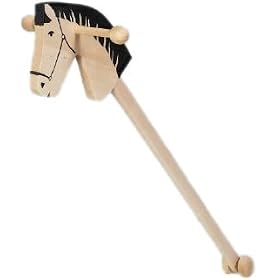
Based on these qualifications, I have come to the conclusion that THE BEST TOY EVER is...this! The Hobby Horse.
Look how cute he is!
He encourages endless imaginative games. Just think of the possibilities! Will the brave Sir Joseph save the people of the village from the scourge of the valley, the great dragon?
Will Cowboy Joe be able to overcome the dangers of the Wild West to stop outlaw Crudely Devious from hustling both his cattle and his girl?
I don't know about you, but I'm ready for an adventure. :D
It's sturdy wooden-ness and delightful little wheels make it ideal for all-terrain play, ready for any weather, inside and out. There are no complicated little pieces or annoying little sounds included. Heck, there isn't even any assembly required. Can it get much better?
That is why the Hobby Horse holds this week's prestigious title of...THE BEST TOY EVER!!!!!
Oh, and hey look, a word!
equestrian
etymology: Latin, from equus, horse
date: 17th century
1a: pertaining to horses or horsemanship; b: consisting in or accompanied with performances on horseback
2: a rider on horseback; one who earns his living by performing feats of agility and skill on horseback, esp. in a circus
Friday, October 23, 2009
Oh. My. Stars.
I just found something that can only be described as legendary: a typo in the dictionary.
Epic fail.
I was looking for a new WOTD (that is, word of the day, not warlock's octogonal tantalizing dog) when I found the following sentence under the word "congenital": Belonging or pertaining to an individual from hirth.
What on earth is hirth?
I looked it up. There is no such word as hirth. Although, considering it was in the same dictionary that made the typo in the first place, I'm not sure who to trust! My preconceived notions have been shaken! I'm so disillusioned.
Hey, look! A word!
Hirth
etymology: ???
date: today??
meaning: ?????
Monday, October 19, 2009
Tada!
Greetings! Welcome to a brand new blog that really has no other purpose than to help me get into college. Posts will consist of random thoughts, rants, begging for story ideas, essays, etc.
One thing you should know is that I am also known as the not-yet-famous-but-almost-there author Hannah-Rose Dakota! Haha, yes, this is my pseudonym for soon-to-be-published stories. More information will be posted as it becomes available.
Feel free to post as you deem it necessary. Bye, now!
Oh, and, Hey look! A word!
superfluous
Etymology: Middle English, from Latin superfluus, literally, running over
Date: 15th century
1a: exceeding what is sufficient or necessary; extra; b: not needed
2: obsolete, marked by wastefulness
Subscribe to:
Posts (Atom)